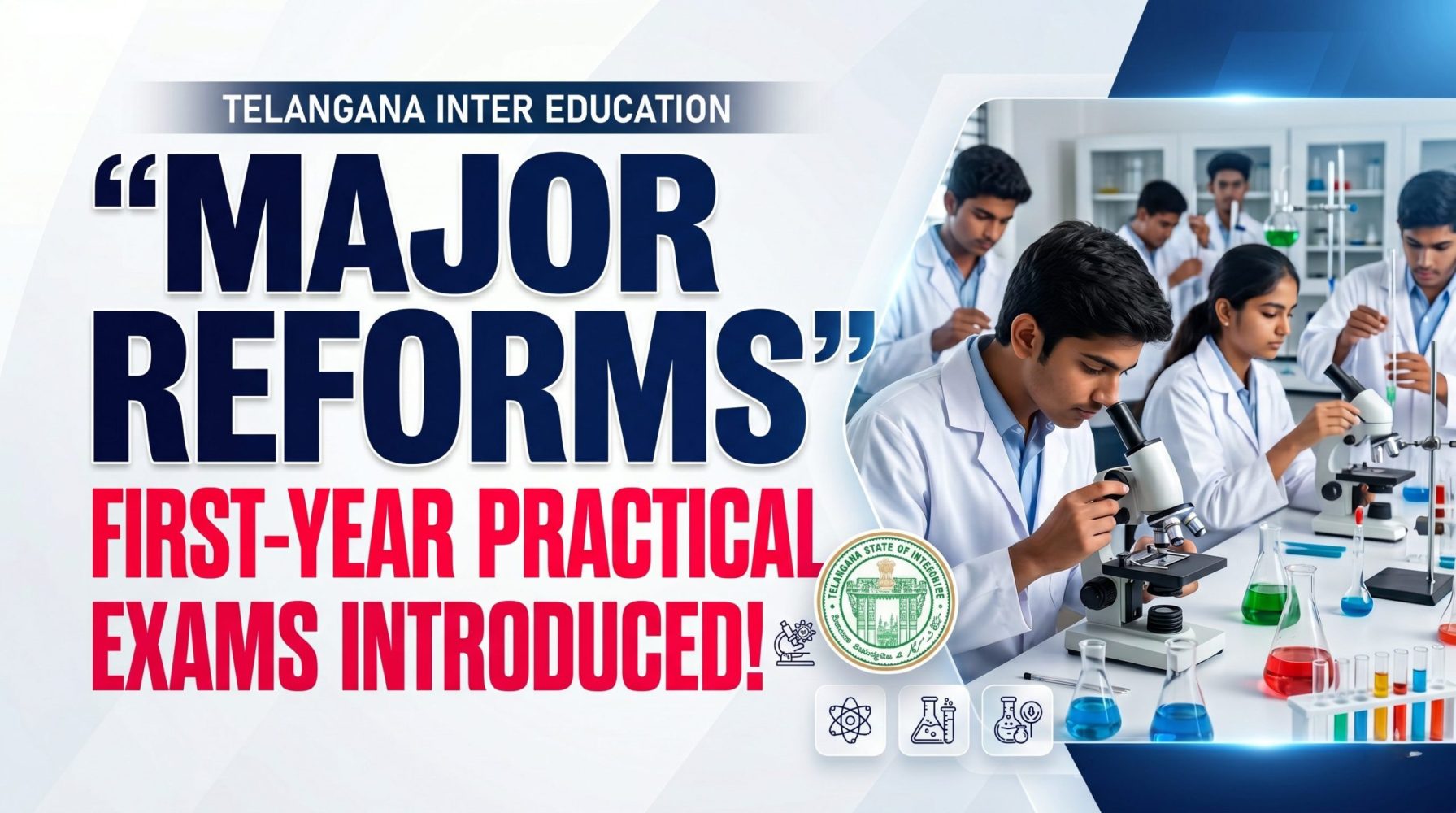
The Telangana government has introduced significant reforms to the Intermediate education system, aiming to modernise learning methods and improve students’ conceptual understanding. The Telangana State Board of Intermediate Education (TSBIE) is introducing major changes to practical examinations, internal assessments, and activity-based learning across the Science, Mathematics, Humanities, and Language subjects.
One of the biggest highlights of the new reforms is the introduction of practical examinations from the first year itself. Until now, practical exams were conducted mainly in the second year for science students. However, under the new system, students will begin practical learning from the first year of Intermediate education.
The reforms are designed to reduce exam pressure, encourage hands-on learning, and improve analytical and practical skills among students. Education experts believe these changes align with the broader goals of the National Education Policy (NEP), which focuses on experiential and skill-based learning.
First-Year Practical Exams Introduced
In a major academic shift, the Telangana Intermediate Board has decided to conduct practical examinations for first-year students in science subjects.
The subjects included are:
- Physics
- Chemistry
- Botany
- Zoology
This change is expected to provide students with early exposure to laboratory experiments and scientific observation techniques.
Practical Marks Distribution
The total practical marks will now be divided between the two years of Intermediate education.
- First Year: 15 Marks
- Second Year: 15 Marks
This means students will now have a total of 30 practical marks spread across both years.
Earlier, practical exams were mostly concentrated in the second year, which created pressure on students. With the revised system, students can gradually build laboratory skills and scientific understanding from the beginning of their Intermediate studies.
Activity-Based Learning Introduced in Mathematics
Another major reform announced by the Telangana Intermediate Board is the introduction of activity-based learning in Mathematics.
Traditionally, Mathematics evaluation relied heavily on final written examinations. The new system aims to move away from rote learning and focus more on conceptual clarity and continuous assessment.
Previous Exam Pattern
- Final Examination: 75 Marks
New Exam Pattern
- Final Examination: 60 Marks
- Internal Assessment: 15 Marks per year
The internal assessment may include:
- Classroom activities
- Assignments
- Concept-based tests
- Problem-solving exercises
- Project work
Education experts believe this system will help students understand mathematical concepts more effectively rather than memorizing formulas mechanically.
Major Changes in Humanities Subjects
The Telangana government is also introducing activity-based learning for Humanities students.
Under the revised structure:
- Final Examination: 80 Marks
- Activity-Based Learning: 20 Marks
The activity-based component may include:
- Presentations
- Group discussions
- Projects
- Field studies
- Research assignments
This reform aims to improve communication skills, critical thinking, and practical understanding of social science concepts among students.
Language Subjects to Have Internal Assessments
Language subjects are also undergoing major changes under the new Telangana Intermediate education reforms.
Previous System
- Final Examination: 100 Marks
Revised System
- Final Examination: 80 Marks
- Internal Assessment: 20 Marks
The internal assessment process may evaluate:
- Speaking skills
- Writing activities
- Seminars
- Reading comprehension
- Communication exercises
Officials believe this approach will improve language proficiency and practical communication skills among students.
Why These Changes Are Important
The Telangana Intermediate Board’s reforms are part of a broader effort to transform the education system from exam-oriented learning to skill-oriented learning.
In today’s competitive world, students need more than textbook knowledge. Educational institutions are increasingly focusing on:
- Practical skills
- Analytical thinking
- Communication abilities
- Problem-solving skills
- Conceptual understanding
The new reforms aim to prepare students for higher education, competitive examinations, and future careers more effectively.
These changes are also aligned with the principles of India’s National Education Policy (NEP), which encourages experiential learning and holistic development.
Benefits for Students
1. Better Practical Knowledge
Introducing practical exams from the first year will help science students gain hands-on laboratory experience earlier than before.
Students will become familiar with:
- Scientific equipment
- Experimental procedures
- Observation methods
- Laboratory safety practices
This will strengthen their understanding of scientific concepts.
2. Reduced Exam Pressure
Since marks are now distributed between final exams and internal assessments, students may experience less pressure during board examinations.
Continuous assessment can help students improve gradually throughout the academic year.
3. Improved Conceptual Understanding
Activity-based learning encourages students to understand concepts deeply instead of relying on memorization.
This method is expected to improve:
- Logical reasoning
- Analytical skills
- Concept clarity
- Academic confidence
4. Enhanced Communication Skills
Presentations, seminars, and project-based learning will help students improve their communication and presentation abilities.
These skills are essential for higher education and professional careers.
5. Better Preparation for Competitive Exams
Students preparing for exams such as:
- JEE
- NEET
- CUET
- UPSC foundation courses
may benefit from stronger conceptual learning and practical exposure.
Challenges for Colleges and Institutions
While the reforms offer several advantages, they also create new responsibilities for colleges and educational institutions.
Institutions may need to:
- Upgrade laboratory infrastructure
- Train faculty members
- Ensure fair internal assessment methods
- Implement activity-based teaching techniques
Colleges lacking adequate facilities may face difficulties during the transition phase.
Teachers Will Play a Key Role
The success of the new education model will largely depend on teachers.
Faculty members will need to adapt to:
- Interactive teaching methods
- Practical demonstrations
- Continuous student evaluation
- Activity-based classroom engagement
Teacher training programs may become essential to implement the reforms effectively.
Parents Welcome the Decision
Many parents have welcomed the Telangana government’s decision to modernize Intermediate education.
Parents believe that reducing dependence on rote learning will help students develop real-world skills and reduce academic stress.
However, some parents and education experts have also emphasized the importance of maintaining transparency in internal assessments.
When Will the Changes Be Implemented?
According to reports from Intermediate Board officials, the reforms are likely to be implemented gradually in the upcoming academic years.
Detailed guidelines and official notifications are expected to be released soon by the Telangana State Board of Intermediate Education.
Students and colleges are advised to stay updated with official announcements regarding:
- Exam patterns
- Internal assessment guidelines
- Practical exam schedules
- Activity-based evaluation methods
Impact on the Future of Education
The Telangana government’s decision could become a model for other states looking to reform Intermediate education systems.
The focus on:
- Practical learning
- Internal assessments
- Skill development
- Experiential education
represents a major shift in how students are evaluated and trained.
Education experts say this transformation could improve not only academic performance but also employability and higher education readiness among students.
Conclusion
The Telangana Intermediate education reforms mark a significant step toward a more modern, student-friendly, and skill-oriented academic system. By introducing practical exams from the first year, activity-based learning, and internal assessments across multiple subjects, the government aims to create a balanced educational environment that focuses on both knowledge and practical application.
These reforms are expected to reduce exam stress, improve conceptual understanding, and help students develop essential academic and life skills. If implemented effectively, the new system could greatly benefit future generations of students in Telangana.