
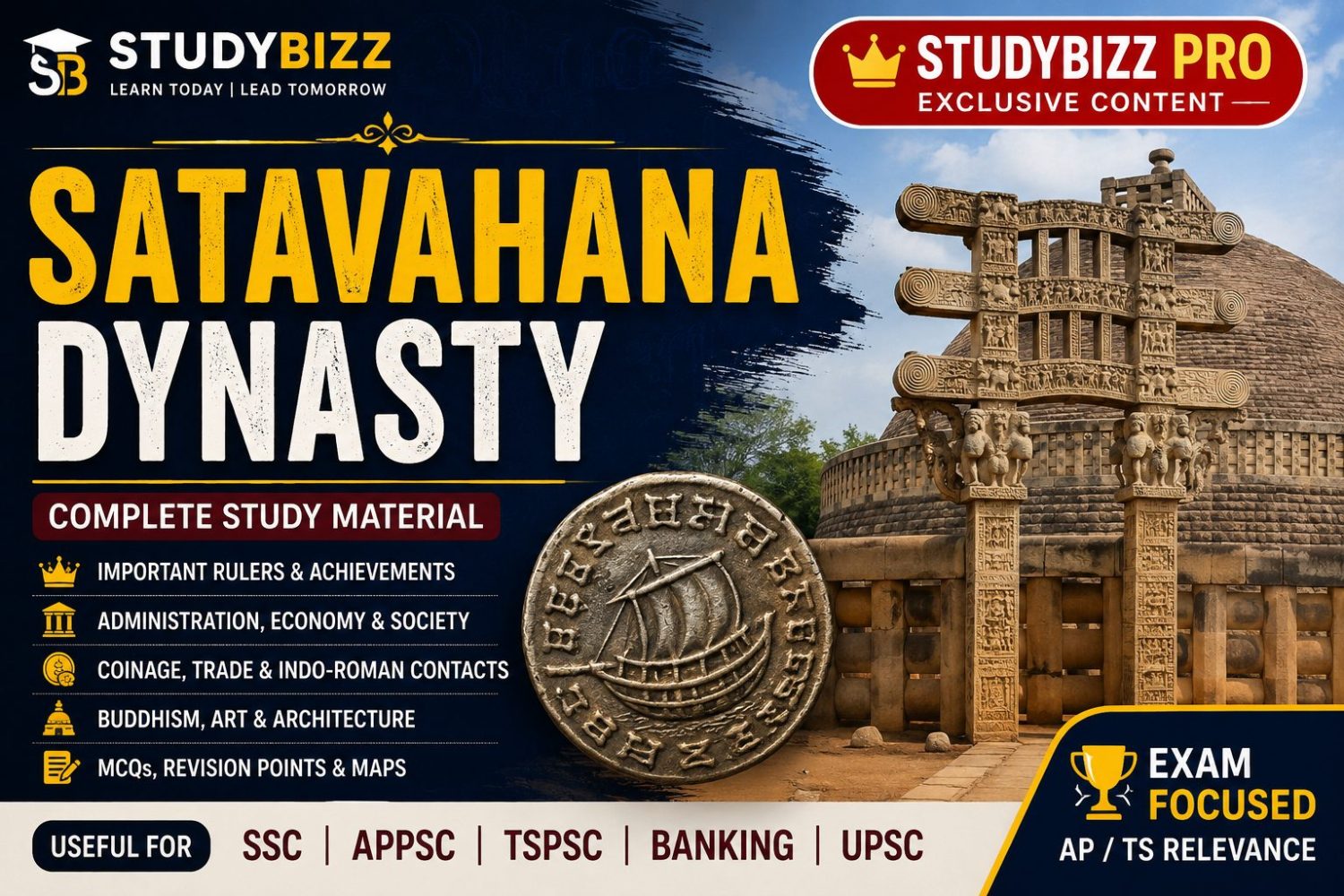
SATAVAHANA DYNASTY
StudyBizz Pro | General Studies
SSC | APPSC | TSPSC | Banking | UPSC Foundation | Special focus: Andhra Pradesh & Telangana
1. Introduction
- The Satavahanas were one of the most important ancient dynasties of the Deccan. They emerged after the decline of Mauryan power and became a major political power in the Deccan.
- The dynasty is particularly important for the history of Andhra Pradesh, Telangana and Maharashtra. The Satavahana period is also significant for trade, Buddhism, Prakrit literature, inscriptions, coinage and art.
- Simuka is generally regarded as the founder of the Satavahana dynasty. The exact date and circumstances of the dynasty’s foundation remain debated.
- Exam Point: Simuka → generally regarded as the founder of the Satavahana dynasty.
- The Satavahanas are also referred to as Andhras in some ancient literary sources. The exact relationship between the terms Satavahana and Andhra has been debated by historians.
2. Origin, Territory and Important Centres
- The early history of the Satavahanas is not completely clear. Evidence comes from inscriptions, coins, Puranic traditions and archaeology.
- At different stages, Satavahana influence extended over parts of present-day Maharashtra, Telangana, Andhra Pradesh, Madhya Pradesh, Karnataka and adjoining Deccan regions.
- Pratishthana (Paithan) in present-day Maharashtra was an important Satavahana capital/centre.
- Dhanyakataka, near Amaravati, was an important political, commercial and Buddhist centre associated with the Satavahana period.
- The Satavahanas were a major Deccan power. Their importance to present-day Andhra Pradesh and Telangana should not be confused with a modern linguistic identity.
3. Important Satavahana Rulers
- Simuka — generally regarded as founder.
- Kanha (Krishna) — early Satavahana ruler.
- Satakarni I — early expansion; associated with major Vedic sacrifices.
- Hala — associated with Gatha Saptashati.
- Gautamiputra Satakarni — greatest/most powerful Satavahana ruler.
- Vashishthiputra Pulumavi — continued the empire after Gautamiputra.
- Yajna Sri Satakarni — important later ruler; associated with maritime trade.
- Chronology caution: Exact reign dates of several early rulers are uncertain.
1. Satakarni I and Naneghat
- Satakarni I was an important early Satavahana ruler associated with expansion and major Vedic sacrifices.
- The Naneghat inscription of his queen Naganika is an important source for the early Satavahana royal family and religious practices.
- Naneghat was also an important pass in the Western Ghats on a route connecting the interior Deccan with the western coast. Its location helps explain the importance of the inscription and the trade route.
- Exam Point: Naganika (Nayanika) was the wife of Satakarni I.
2. Gautamiputra Satakarni
- Gautamiputra Satakarni is generally regarded as the greatest and most powerful ruler of the Satavahana dynasty.
- He expanded Satavahana power and defeated the Shaka ruler Nahapana, helping restore Satavahana authority in western India.
- He is associated with victories over groups including Shakas, Yavanas and Pahlavas.
- Important exam chain: Gautamiputra Satakarni → Nahapana → Shakas/Western Kshatrapas.
- Titles associated with him include Eka-Brahmana and Trisamudra-toya-pita-vahana.
- His mother was Gautami Balashri. Her Nasik inscription is an important source for his achievements.
3. Vashishthiputra Pulumavi
- Vashishthiputra Pulumavi succeeded Gautamiputra Satakarni.
- He continued Satavahana power in the Deccan and is particularly associated with the eastern Deccan.
- Exam Point: Gautamiputra Satakarni → Vashishthiputra Pulumavi.
4. Yajna Sri Satakarni
- Yajna Sri Satakarni was an important later Satavahana ruler.
- He is associated with recovery of some western territories, maritime trade and coinage.
- Coins associated with Yajna Sri Satakarni include a ship motif, an important indication of sea-borne trade.
- Exam chain: Yajna Sri Satakarni → Ship coin → Maritime trade.
4. Administration
- The Satavahana king was the central authority.
- Important administrative structure: King → Aharas → Villages.
- Ahara was an important territorial/administrative unit.
- The village was the basic local unit and was associated with an official called the Gramika.
- Important administrative terms include Amatyas, Gramika, Maharathis and Mahabhojas.
- Local/subordinate chiefs played an important role in administration.
5. Economy, Trade and Guilds
- Agriculture was an important foundation of the economy.
- Revenue was collected in cash as well as kind.
- Crafts included weaving, pottery, metalworking and other occupations.
- Guilds or Shrenis played an important role in economic activity.
- Trade developed between different parts of the Deccan and with overseas regions.
- Satavahana trade was connected with the Roman world. Important exports included textiles and other valuable goods.
- Pratishthana and Tagara were important inland commercial centres. The western coast provided access to maritime trade.
- The ancient north–south route known as Dakshinapatha connected the northern regions with the Deccan and western coast. Pratishthana was an important centre on this network.
6. Indo-Roman Trade
- The Satavahana period saw important overseas commercial links with the Roman world.
- The Periplus of the Erythraean Sea, a 1st-century CE account, is an important source for understanding India’s overseas trade.
- Indian exports mentioned in ancient trade accounts included spices, perfumes, jewels, ivory and fine textiles/muslin.
- Pratishthana and Tagara were associated with inland trade routes leading towards western coastal ports.
- Exam connection: Satavahana period → Deccan trade routes → western ports → overseas/Roman trade.
7. Satavahana–Shaka Conflict
- The Satavahanas repeatedly came into conflict with the Western Kshatrapas/Shakas.
- Nahapana was an important Western Kshatrapa ruler and a major rival of Gautamiputra Satakarni.
- The struggle was also strategically important because control over western Deccan routes and ports affected commerce.
- Important western ports connected with this wider commercial region included Bharuch (Barygaza), Kalyan and Sopara.
- Exam point: Gautamiputra’s victory over Nahapana was important both politically and for restoring Satavahana influence in western India.
8. Coinage
- Coinage is an important source for Satavahana history.
- Satavahana coins were issued in different metals; lead coins are particularly associated with the dynasty.
- Coins carried symbols and motifs.
- Yajna Sri Satakarni is associated with coins bearing a ship motif, reflecting the importance of maritime activity.
- StudyBizz source material records Satavahana coins from places including Kotilingala and Kondapur.
- Exam chain: Yajna Sri → ship coin → maritime trade.
9. Society and Matronymics
- Satavahana society had a strong varna-based social structure along with diverse local traditions.
- Satavahana rulers presented themselves as supporters of the Brahmanical social order.
- Women of the royal family appear prominently in inscriptions.
- Royal names using matronymics are notable: Gautamiputra Satakarni and Vashishthiputra Pulumavi.
- Matronymic means a name derived from or indicating the mother’s name.
- Important caution: the use of matronymics does not by itself prove that Satavahana succession was matrilineal.
10. Religion
- The Satavahana period witnessed the coexistence and patronage of Brahmanical traditions and Buddhism.
- Some rulers performed Vedic sacrifices; Satakarni I is particularly associated with major Vedic sacrifices.
- Buddhism also flourished significantly. Amaravati was an important Buddhist centre; Nagarjunakonda became especially prominent in the later Andhra/Ikshvaku context.
- Exam-ready statement: Satavahana rulers patronised Brahmanical traditions while Buddhism also received substantial support through royal and private donations.
11. Art and Architecture
- The Satavahana period is especially important for Buddhist architecture and sculpture in the Deccan.
- Amaravati became one of the most important centres of Buddhist art. The Amaravati Stupa is a major monument associated with the region.
- Amaravati art is known for Buddhist themes, narrative reliefs, detailed figures and decorative sculptural panels, commonly using white limestone.
- Other important sites include Amaravati, Nagarjunakonda, Nasik, Karle and Kanheri.
12. Inscriptions – Important Sources
- Naneghat Inscription — associated with Naganika; important for early Satavahana genealogy, royal family and Vedic sacrifices.
- Nasik Inscriptions — important for Gautamiputra Satakarni and Gautami Balashri.
- Amaravati Inscriptions — useful for religious and social history of the Buddhist centre.
- Junagadh Inscription of Rudradaman I — important for understanding the conflict between the Western Kshatrapas and Satavahanas.
- Kanheri inscriptions also contribute to knowledge of the period.
13. Sources for Satavahana History
- Inscriptions — rulers, genealogy, donations, religious practices and administration.
- Coins — rulers, symbols, economy and trade.
- Puranic accounts — dynastic lists and traditions.
- Archaeology — settlements, monuments, crafts and material culture.
- Buddhist monuments and inscriptions — patronage, religious life and society.
- Periplus of the Erythraean Sea — valuable evidence for overseas trade and commercial geography.
- Exam concept: Historians reconstruct Satavahana history by combining different types of evidence rather than relying on a single source.
14. Literature
- Prakrit was an important language of Satavahana inscriptions and literature.
- Gatha Saptashati — associated with King Hala; composed in Prakrit; about 700 verses; mainly deals with love and aspects of social life.
- Brihatkatha — associated with Gunadhya.
- Katantra Vyakarana — associated with Sharvavarma.
- Editorial caution: Some literary attributions involve scholarly debate; debated traditions should not be presented as absolute facts.
15. Important Places – AP/TS Focus
- Kotilingala — important Satavahana archaeological site in Telangana.
- Kondapur — important archaeological site in Telangana.
- Amaravati — major Buddhist and artistic centre in Andhra Pradesh.
- Dhanyakataka — important centre associated with the Amaravati region.
- Nagarjunakonda — major Buddhist centre of the later Andhra/Ikshvaku period.
- Pratishthana (Paithan) — major Satavahana capital/centre in Maharashtra.
- Naneghat — important inscriptional and trade-route site in Maharashtra.
- Nasik — important inscriptions and cave sites.
- Bharuch/Barygaza — important western commercial port.
16. Map-Based Revision
- Locate on an India map: Kotilingala, Kondapur, Amaravati, Dhanyakataka, Nagarjunakonda, Pratishthana/Paithan, Naneghat, Nasik and Bharuch/Barygaza.
- Why this matters: APPSC/TSPSC learners benefit from connecting historical centres with present-day states and ancient trade routes.
17. Decline of the Satavahanas
- The Satavahana dynasty declined during the 3rd century CE.
- The decline was gradual and involved weakening central authority, emergence of regional powers, political fragmentation and loss of territories.
- In the Andhra region, the Ikshvakus emerged as an important successor power.
- Important correction: The Satavahanas were not directly succeeded everywhere by one single dynasty. Different successor powers emerged in different regions.
18. Historical Caution – Avoid These Common Errors
- Do not present 246 BCE as a universally accepted foundation date.
- Do not state that Kotilingala was unquestionably the first Satavahana capital.
- Do not describe the Satavahanas simply as a modern ‘Telugu dynasty’; their political sphere covered a large part of the Deccan and their inscriptions are predominantly in Prakrit.
- Do not treat matronymics as proof of matrilineal succession.
- Do not give overly precise reign dates where chronology is disputed.
- Do not claim that the Satavahanas were exclusively Hindu; Brahmanical and Buddhist traditions both received patronage.
- Do not present Nagarjunakonda as a purely Satavahana monument; its major Buddhist development is especially associated with the later Ikshvaku period.
19. SATAVAHANA QUICK REVISION
- Founder — Simuka
- Important early ruler — Satakarni I
- Queen associated with Naneghat — Naganika
- Greatest ruler — Gautamiputra Satakarni
- Major rival defeated by Gautamiputra — Nahapana
- Mother of Gautamiputra — Gautami Balashri
- Successor — Vashishthiputra Pulumavi
- Important later ruler — Yajna Sri Satakarni
- Famous literary work — Gatha Saptashati
- Author — Hala
- Main literary language — Prakrit
- Important Buddhist centre — Amaravati
- Important inscription — Naneghat
- Important Telangana site — Kotilingala
- Administrative unit — Ahara
- Village official — Gramika
- Important feudatories — Maharathis and Mahabhojas
- Famous coin symbol — Ship, associated with Yajna Sri Satakarni
- Important successor in Andhra region — Ikshvakus
- Important trade route — Dakshinapatha
20. 20 HIGH-VALUE EXAM FACTS
- 1. Simuka is generally regarded as the founder of the Satavahana dynasty.
- 2. The Satavahanas were a major power of the Deccan.
- 3. Pratishthana (Paithan) was an important Satavahana capital.
- 4. Satakarni I was an important early Satavahana ruler.
- 5. Naganika was the wife of Satakarni I.
- 6. The Naneghat inscription is associated with Naganika.
- 7. Gautamiputra Satakarni is regarded as the greatest Satavahana ruler.
- 8. Gautamiputra defeated Nahapana.
- 9. Nahapana was a Western Kshatrapa/Shaka ruler.
- 10. Gautami Balashri was the mother of Gautamiputra Satakarni.
- 11. The Nasik inscription is an important source for Gautamiputra’s reign.
- 12. Vashishthiputra Pulumavi succeeded Gautamiputra.
- 13. Yajna Sri Satakarni was an important later ruler.
- 14. The ship motif on Satavahana coins is associated with maritime activity.
- 15. Prakrit was an important language of Satavahana inscriptions and literature.
- 16. Hala is associated with Gatha Saptashati.
- 17. Amaravati was a major Buddhist centre.
- 18. Ahara was an important administrative division.
- 19. Gramika was associated with village administration.
- 20. The Ikshvakus emerged as an important successor power in the Andhra region.
21. 15 MCQs – StudyBizz Pro
- 1. Who is generally regarded as the founder of the Satavahana dynasty? A) Satakarni I B) Simuka C) Gautamiputra Satakarni D) Hala — Answer: B) Simuka
- 2. Naganika was the wife of: A) Simuka B) Kanha C) Satakarni I D) Gautamiputra Satakarni — Answer: C) Satakarni I
- 3. Which inscription is associated with Naganika? A) Junagadh B) Naneghat C) Hathigumpha D) Allahabad — Answer: B) Naneghat
- 4. Who is considered the greatest Satavahana ruler? A) Hala B) Simuka C) Gautamiputra Satakarni D) Yajna Sri Satakarni — Answer: C) Gautamiputra Satakarni
- 5. Gautamiputra Satakarni defeated: A) Kanishka B) Nahapana C) Rudradaman D) Menander — Answer: B) Nahapana
- 6. Gautami Balashri was the: A) Wife of Satakarni I B) Daughter of Hala C) Mother of Gautamiputra Satakarni D) Wife of Yajna Sri Satakarni — Answer: C) Mother of Gautamiputra Satakarni
- 7. Which was an important Satavahana administrative unit? A) Bhukti B) Ahara C) Mandalam D) Vishaya — Answer: B) Ahara
- 8. The village official was known as: A) Gramika B) Amatya C) Mahabhoja D) Senapati — Answer: A) Gramika
- 9. Gatha Saptashati is associated with: A) Gunadhya B) Hala C) Sharvavarma D) Nagarjuna — Answer: B) Hala
- 10. Gatha Saptashati was composed in: A) Sanskrit B) Tamil C) Prakrit D) Pali — Answer: C) Prakrit
- 11. Which place is particularly associated with Satavahana-period Buddhist art? A) Amaravati B) Sarnath C) Taxila D) Nalanda — Answer: A) Amaravati
- 12. Which ruler is associated with ship motifs on coins? A) Simuka B) Satakarni I C) Gautamiputra Satakarni D) Yajna Sri Satakarni — Answer: D) Yajna Sri Satakarni
- 13. Which was a Satavahana feudatory title? A) Maharathi B) Sultan C) Iqta-dar D) Mansabdar — Answer: A) Maharathi
- 14. Which dynasty emerged as an important successor to the Satavahanas in the Andhra region? A) Cholas B) Ikshvakus C) Pallavas D) Rashtrakutas — Answer: B) Ikshvakus
- 15. Which combination is correct? A) Hala — Gatha Saptashati B) Gautamiputra — Arthashastra C) Simuka — Rajatarangini D) Satakarni I — Mudrarakshasa — Answer: A) Hala — Gatha Saptashati
22. Sources & Editorial Note
- Primary StudyBizz source: user-provided Satavahana material.
- Cross-check basis: NCERT educational material, NIOS history material and Government of Andhra Pradesh school textbook material, supplemented by authoritative archaeological/academic references for the additional trade-route and source points.
- Editorial principle: uncertain chronology and debated historical claims are identified or omitted rather than presented as established facts.
- Prepared as original, exam-oriented StudyBizz Pro material for SSC, APPSC, TSPSC, Banking and UPSC foundation learners.
StudyBizz reference page: https://studybizz.com/education/satavahana-dynasty